
ETFs vs. Mutual Funds: Which Gives You More Control?
ETFs and mutual funds both offer a way to invest in a diversified portfolio, but they work differently. Learn the key differences between ETFs and mutual funds, including how they're traded, managed, and priced


On this page
If you're new to investing, you've likely encountered the terms exchange-traded fund (ETF) and mutual fund. Both are popular investment vehicles that can provide access to a diversified portfolio but the real difference between them comes down to how much control you actually have over your money day to day.
Although ETFs and mutual funds share many similarities, they operate differently in areas such as trading, pricing, costs, and investment management. Understanding these differences can help you make more informed decisions as you build your investment knowledge.
What is an ETF?
An exchange-traded fund (ETF) is an investment fund that holds a collection of assets, such as stocks, bonds, or commodities, and trades on a stock exchange throughout the trading day.
When you buy an ETF, you're purchasing shares in a fund rather than buying each underlying investment individually. Many ETFs are designed to track the performance of an index, such as the S&P 500 or Nasdaq-100, although there are also actively managed ETFs.
Because ETFs trade on stock exchanges, their prices change throughout the trading day based on market demand - which means you control exactly when you buy and sell, at the price the market is showing you in that moment.
What is a Mutual Fund?
A mutual fund is also a pooled investment that combines money from multiple investors to purchase a portfolio of assets.
Unlike ETFs, mutual funds are generally bought and redeemed directly through the fund provider. Rather than trading throughout the day, mutual funds are typically priced once each trading day based on the fund's net asset value (NAV) - meaning you hand over that pricing control: whatever the closing NAV turns out to be is the price you get, whether the market moved in your favor that day or not.
Mutual funds may be actively managed, where professional fund managers make investment decisions, or passively managed, where the fund tracks a specific market index.
The Control Comparison: ETFs vs. Mutual Funds
Here's the control trade-off broken down directly:
- When you can trade
- ETFs: Anytime the market is open.
- Mutual funds: Once per day, after the market closes.
- Price you get
- ETFs: The live market price at the time of your trade.
- Mutual funds: The end-of-day NAV, calculated after you've placed the order.
- Minimum to start
- ETFs: Vantar allows you to invest with as little as $1 using fractional shares.
- Mutual funds: Often have a fixed minimum, which varies by provider and may be $500 – $3,000 or more.
- How you buy
- ETFs: Through a brokerage that supports exchange-traded funds.
- Mutual funds: Usually directly through the fund provider.
The pattern across every row: ETFs put the timing, the price, and the entry point in your hands. Mutual funds put those same three decisions in the fund provider's hands instead.
ETFs vs. Mutual Funds: Key Differences
Although ETFs and mutual funds both provide diversified investing opportunities, they differ in several important ways.
Trading
One of the biggest differences is how investors buy and sell them.
ETFs trade on stock exchanges throughout the day, just like individual stocks. Investors can buy or sell ETF shares whenever the market is open, and prices fluctuate continuously.
Mutual funds, however, are generally bought or redeemed at the end of the trading day. All transactions are processed at the fund's closing net asset value (NAV), regardless of when the order was placed during the day.
Pricing
Because ETFs trade on exchanges, their prices change throughout the trading session based on supply and demand. On Vantar, ETFs can be bought as fractional shares starting at $1 - so the control over price and control over entry size both stay with you.
Here's what that looks like in practice:
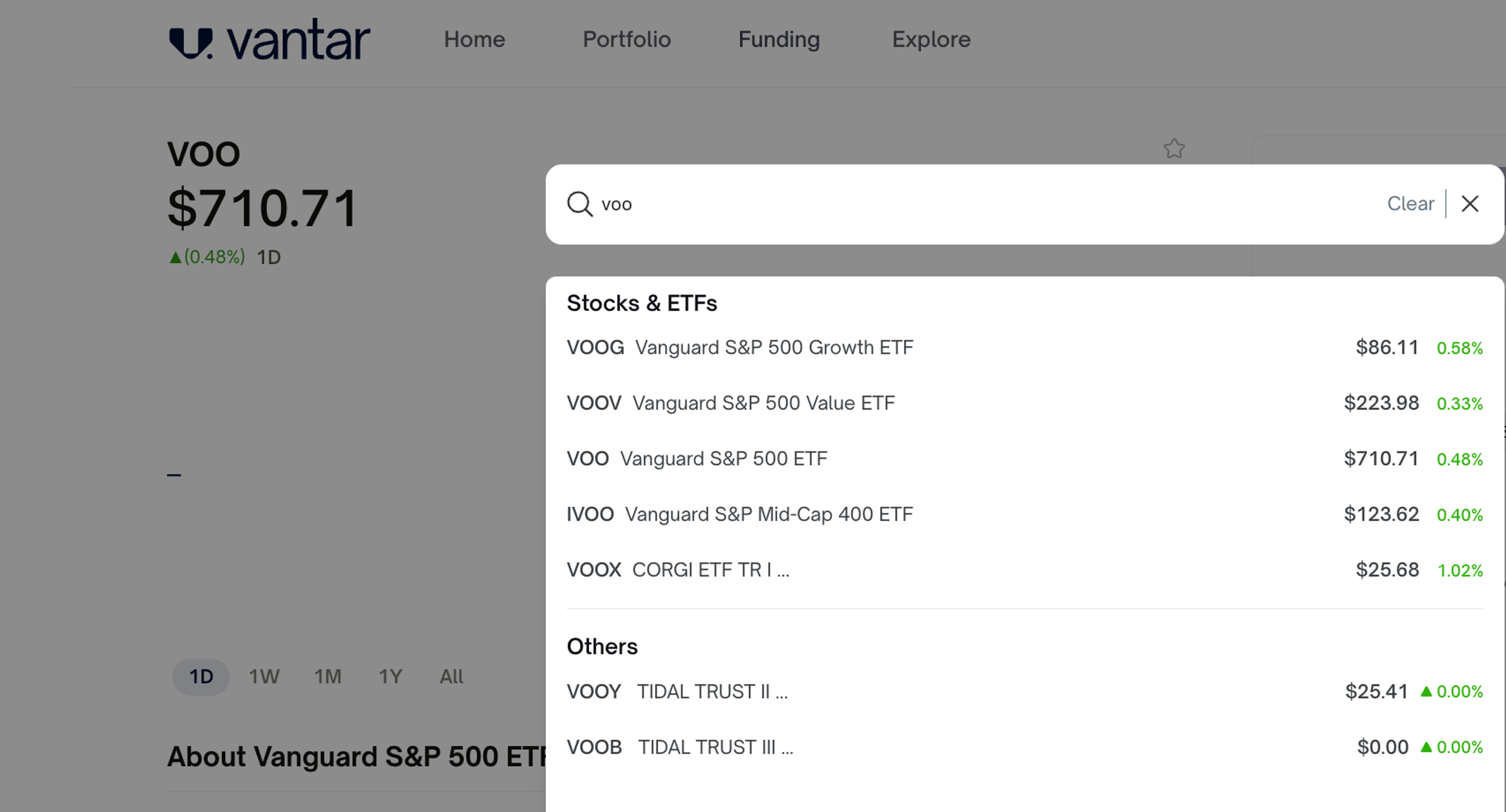
The Vanguard S&P 500 ETF (VOO) recently traded at $710.71 per share - a price point that would put a whole share out of reach for many new investors. At that price, $1 buys roughly 0.0014 of a share ($1 ÷ $710.71). Your ownership rises and falls with VOO's price, just like a whole share would.
Mutual funds are priced only once each business day after the market closes, using the value of the underlying investments held by the fund.
Investment Management
Both ETFs and mutual funds can be actively or passively managed.
Passive funds typically seek to track an index, while active funds aim to outperform a benchmark through professional investment management.
Historically, ETFs have been more closely associated with passive investing, although actively managed ETFs have become increasingly common.
Costs
Investment costs vary depending on the fund.
Many passive ETFs have relatively low expense ratios because they simply track an index rather than relying on active portfolio management. Vantar charges $0 commission on ETF trades, which removes one more cost variable from the equation entirely.
Some actively managed mutual funds may have higher fees to cover research, portfolio management, and operational expenses.
Investors should always review a fund's fee structure before investing.
Minimum Investment
Some mutual funds require a minimum initial investment. It varies by provider, often ranging from a few hundred to several thousand dollars, and the fund sets it rather than you.
Here's what that means in practice. Say you can invest $100 a month:
- If a mutual fund has a $1,000 minimum, you'd need to save for 10 months before you could invest, unless the provider lowers the minimum for automatic monthly contributions, which some do.
- With fractional ETF shares on Vantar, you can invest smaller amounts without waiting to reach a whole-share or fixed minimum, subject to the platform's terms.
Similarities Between ETFs and Mutual Funds
Despite their differences, ETFs and mutual funds have much in common.
Both can provide:
- Diversification across multiple investments.
- Professional management or index tracking.
- Exposure to different industries, countries, or asset classes.
- Opportunities for long-term investing.
For many investors, either investment type can serve as part of a diversified portfolio.
ETFs on Vantar
Vantar gives you access to 12,000+ US stocks and ETFs, all commission-free. ETFs offer the control described above: live pricing, flexible entry size, and trading whenever the market is open. That puts the decisions in your hands rather than in a fund provider's once-a-day process.
Which Investment Might Suit Different Investors?
There is no universally "better" option.
An ETF may appeal to investors who value intraday trading, flexibility, and lower-cost index investing - in other words, investors who want to hold onto control themselves.
A mutual fund may appeal to investors who prefer professional active management, automatic investment plans, or employer-sponsored retirement accounts - investors who are comfortable trading some control for a more hands-off structure.
The right choice depends on your investment objectives, financial goals, time horizon, and tolerance for risk.
Common Misconceptions About ETFs and Mutual Funds
- ETFs are only for experienced investors - Not necessarily. Many beginner investors use broad-market ETFs to get diversified exposure through a single investment.
- Mutual funds always outperform ETFs - Not always. Performance depends on the fund's strategy, market conditions, fees, and management, not simply whether it's an ETF or a mutual fund.
- You need a lot of money to invest - Many investment platforms now offer fractional shares or low minimum investment options, making both ETFs and mutual funds more accessible than in the past. On Vantar specifically, that minimum is $1.
Read Also - How to read a stock
Final Thoughts
Understanding ETFs vs. mutual funds is an important step in learning about investing.
Both investment vehicles provide diversified exposure and can support a long-term investment strategy. While ETFs offer intraday trading and are often associated with lower-cost index investing, mutual funds provide a wide range of active and passive investment options that may suit different investor needs.
More guides in Investing Basics.
The real question isn't which is objectively better - it's how much control you want over the timing, price, and size of your own trades. If the answer is "as much as possible”, that's exactly what ETFs and the $1 minimum to start investing on Vantar are built for.
Frequently asked questions
What is the difference between ETFs and mutual funds?
The main differences are how they trade, how they're priced, their fee structures, and how investors buy and sell them. ETFs trade throughout the day on stock exchanges, while mutual funds are generally priced once daily.
Are ETFs better than mutual funds?
Neither is inherently better. The right choice depends on an investor's financial goals, investment horizon, preferred investment style, and risk tolerance.
Can beginners invest in ETFs?
Yes. Many beginners choose broad-market ETFs because they provide diversified exposure through a single investment.
Do ETFs pay dividends?
Some ETFs distribute dividends received from the underlying companies they hold, while others may reinvest those distributions depending on the fund's structure.
Are mutual funds actively managed?
Some mutual funds are actively managed, while others track market indices. Investors should review a fund's investment objective and strategy before investing.
Which has lower fees: ETFs or mutual funds?
Fees vary by fund. Many passive ETFs have relatively low expense ratios, but costs should always be reviewed on a fund-by-fund basis.
Can you lose money investing in ETFs or mutual funds?
Yes. Like all investments, ETFs and mutual funds can rise or fall in value, and investors may lose some or all of their investment depending on market conditions and the assets held within the fund.
Keep reading
All Learn articles
Stocks vs. ETFs for beginners: how each works, and how to start with either
A stock is one company. An ETF is a basket. Here's how each works, what's different, and how to start with a small amount.
 Vantar

Market order vs. limit order: what's the difference?
A market order fills fast; a limit order sets your price. A breakdown on how each works, when to use it, and the trade-offs.
Vantar
From $1 to Generational Wealth: A Guide to Investing With Small Amounts
How to start investing with $1: how fractional shares work, what $1 can actually buy, the costs to watch, and how small habits compound over time.
Vantar